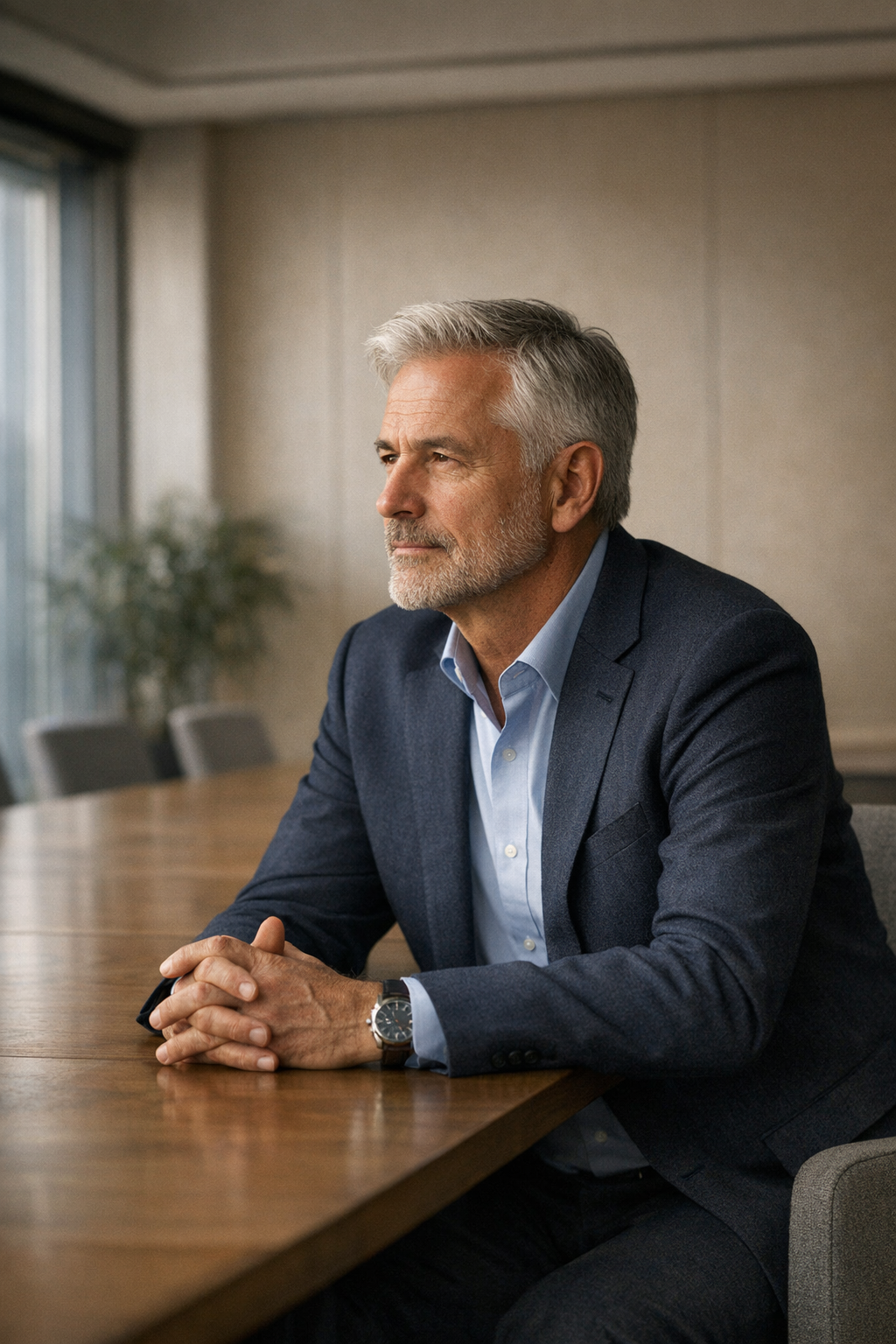


Uncertainty is a peculiar landscape. It is not always an open crisis where everything is clearly named. More often it is subtle, harder to grasp, and therefore more likely to seep under the surface of everyday work. People do not know what will happen or where they stand. In such a space, leadership stops leaning on routines and starts leaning on the human being who leads.
When conditions are stable, leadership can look relatively easy. But as certainty fades, the center of gravity moves elsewhere, toward the quality of presence of the person leading. People react less to the content of a message and more to the state from which it is delivered: what the leader carries in the body, in the voice, and in the overall way of meeting the moment.
Trust reveals itself in small moments
Trust does not show itself only in major strategic decisions. It reveals itself in the subtle moments when words and inner experience are no longer aligned. When reassurance does not feel calm. When confidence is not supported by inner steadiness. When the form still holds, but contact quietly disappears.
In those moments, another capacity becomes visible, one that cannot be transferred through method alone: the ability to hold two levels at the same time. On one level there is very human experience, uncertainty, pressure, doubt, sometimes fear. On another level there is a steadier layer of awareness capable of carrying that experience without being overwhelmed by it.
Carrying experience without losing your ground
This steadier layer does not separate from reality. It does not deny tension. It simply creates enough inner space so the leader can stay in contact with themselves and with others while things are moving. From there, trust becomes possible, because people sense that the leader is not pretending certainty. They are staying present.
And this matters. In uncertain periods some leaders react by increasing pressure, speeding everything up, and tightening control. It can look effective in the short term, but over time it weakens trust. Leaders who remain connected to themselves while acknowledging reality create a different kind of environment, one where people do not need to fake certainty in order to keep moving.
Uncertainty does not require false certainty
Trust in uncertainty does not come from ready-made answers. It comes from the quality of presence. From the fact that a leader remains in contact even when answers are not yet available. That is why a sentence like “we do not know exactly how, but we will move through this together” can either feel empty or deeply reassuring. The difference lies in the inner place from which it is spoken.
Perhaps the task is not to conquer uncertainty. Perhaps the task is not to lose yourself in it, and to lead from there.
In the end, trust does not grow from certainty in the external situation. It grows from inner steadiness and the courage to stay truthful while the future is still unclear.